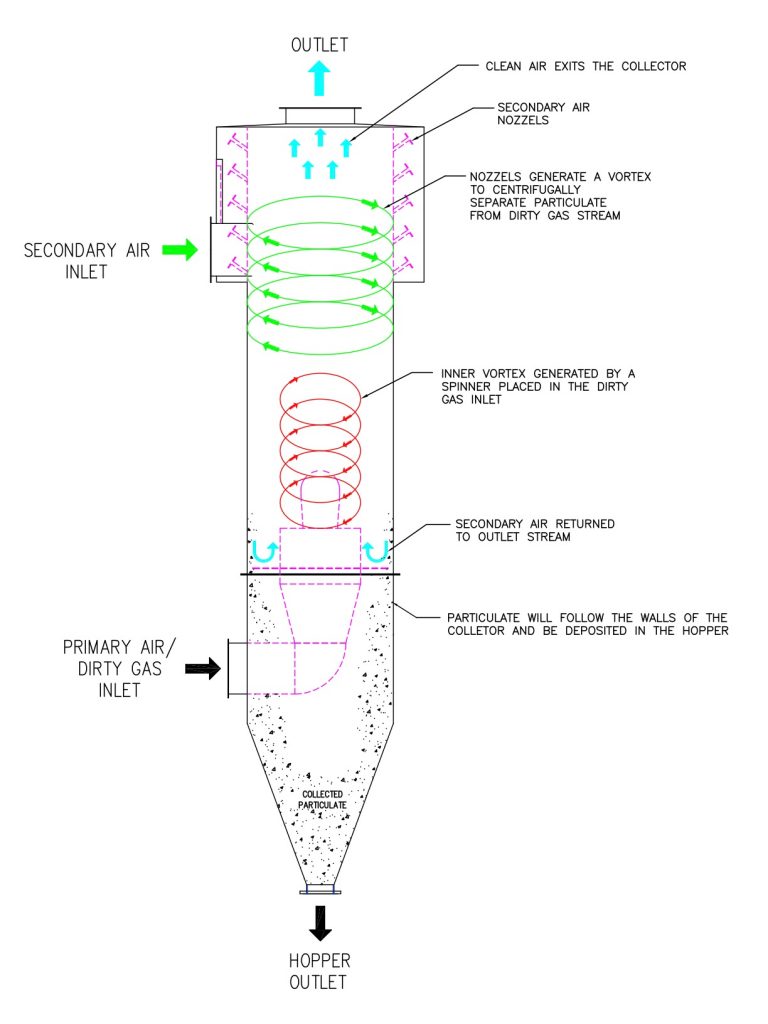
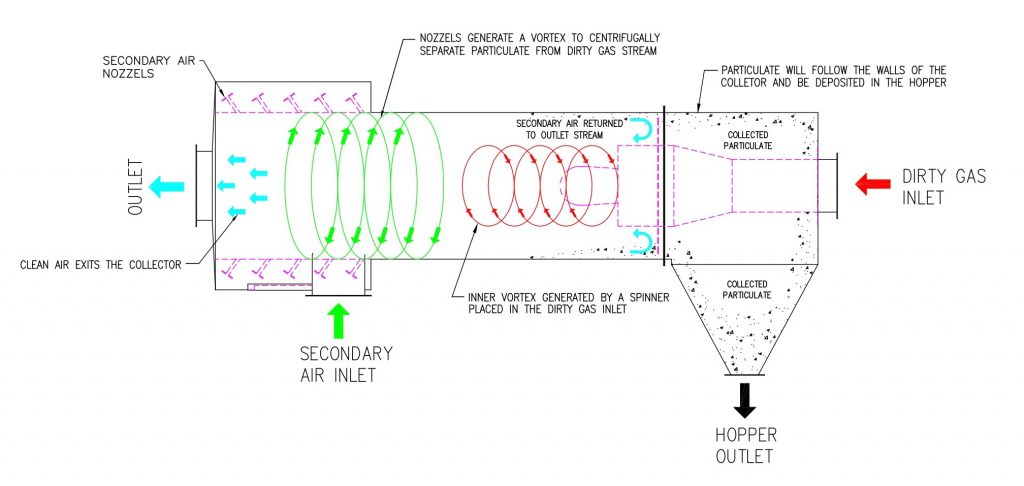
They are used in solid / gas mixtures to separate solid particles from air. Solid / gas mixture entering the cylindrical silo from the upper side follows a helical path until it reaches the bottom of the silo under the effect of centrifugal force. At the end of this path, the solid particles remain in the lower conical part of the vertical cylindrical silo (cyclone) due to the density difference caused by the centrifuge force, while the air leaves the cyclone in the vertical direction from the throat, which is in the form of two intertwined throats and extends towards the top of the silo. While cyclones can hold all coarse solid particles of 50 microns and above, they have difficulty in holding solid particles below 10 microns. Although they are not sufficient by themselves in terms of efficiency, they are effective in reducing the dust load to the filter before bag filters.
Although the dust holding efficiency is low compared to ESP and bag filters, they are capable of being designed in accordance with all kinds of dust structures and high temperatures due to their purely mechanical nature.
Multicyclones,
Multicyclones consist of multiple small cyclones placed in a square or rectangular section body. It provides separation of solids from air / gas phase by using centrifugal force on the same principle as cyclones. Particle sizes that multicyclones can hold are much smaller than conventional cyclones, as well as higher dust holding efficiency. Multi cyclones have higher pressure drop than single cyclone separators and require more energy to clean the same amount of air. A single-chamber cyclone separator of the same volume is more economical, but does not remove too much dust.
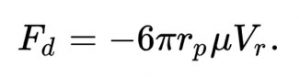
As the cyclone is essentially a two phase particle-fluid system, fluid mechanics and particle transport equations can be used to describe the behaviour of a cyclone. The air in a cyclone is initially introduced tangentially into the cyclone with an inlet velocity (Vin ). Assuming that the particle is spherical, a simple analysis to calculate critical separation particle sizes can be established. If one considers an isolated particle circling in the upper cylindrical component of the cyclone at a rotational radius of ( r ) from the cyclone’s central axis, the particle is therefore subjected to drag, centrifugal, and buoyant forces. Given that the fluid velocity is moving in a spiral the gas velocity can be broken into two component velocities: a tangential component, (Vt ) and an outward radial velocity component (Vr ). Assuming Stokes’ law, the drag force in the outward radial direction that is opposing the outward velocity on any particle in the inlet stream is:
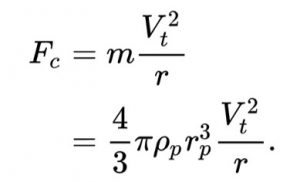
Using ( ρp ) as the particle’s density, the centrifugal component in the outward radial direction is:
The buoyant force component is in the inward radial direction. It is in the opposite direction to the particle’s centrifugal force because it is on a volume of fluid that is missing compared to the surrounding fluid.
Using ( ρf ) for the density of the fluid, the buoyant force is:
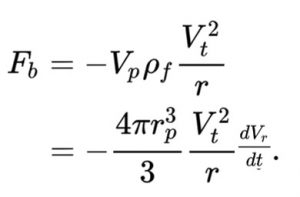
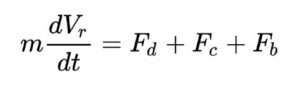
In this case, (Vp ) is equal to the volume of the particle (as opposed to the velocity). Determining the outward radial motion of each particle is found by setting Newton’s second law of motion equal to the sum of these forces:

To simplify this, we can assume the particle under consideration has reached “terminal velocity”, i.e., that its acceleration is zero. This occurs when the radial velocity has caused enough drag force to counter the centrifugal and buoyancy forces. This simplification changes our equation to:
Which expands to:

Solving for (Vr ) we have
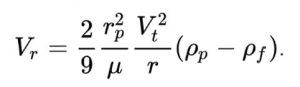
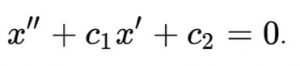
Notice that if the density of the fluid is greater than the density of the particle, the motion is (-), toward the center of rotation and if the particle is denser than the fluid, the motion is (+), away from the center. In most cases, this solution is used as guidance in designing a separator, while actual performance is evaluated and modified empirically. In non-equilibrium conditions when radial acceleration is not zero, the general equation from above must be solved. Rearranging terms we obtain

Since (Vr ) is distance per time, this is a 2nd order differential equation of the form
Experimentally it is found that the velocity component of rotational flow is proportional to (r2 )
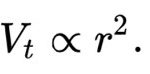
therefore:
This means that the established feed velocity controls the vortex rate inside the cyclone, and the velocity at an arbitrary radius is therefore:
Subsequently, given a value for (Vt ), possibly based upon the injection angle, and a cutoff radius,
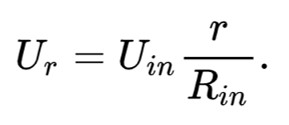
a characteristic particle filtering radius can be estimated, above which particles will be removed from the gas stream.